
SPECIAL SESSION SUBMISSIONS
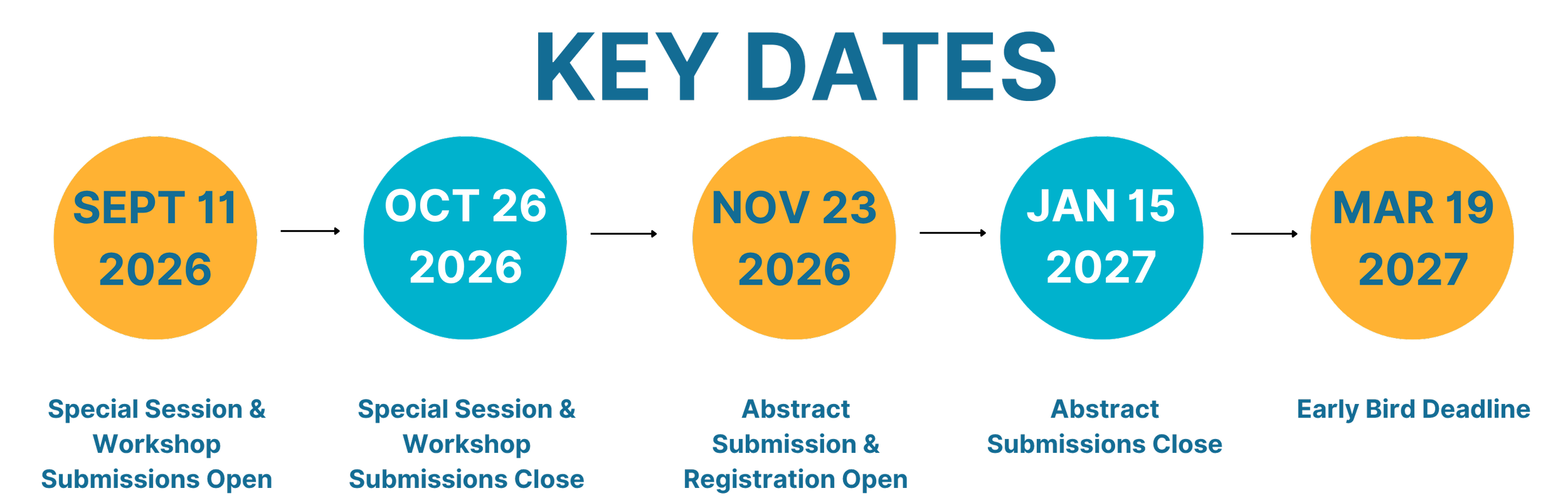
Deadline to Submit: October 26 2026 at 11:59 PM (CST)
Special Session Proposal Submission Details
We are excited to announce the call for Special Session Proposals and Workshop Proposals for the 2027 Annual Meeting of the Society for Freshwater Science.
We invite you to propose Special Sessions related to the meeting theme “Navigating Braided Waters: Past, Present, Future” or other emerging topics related to freshwater science. Special Sessions will complement contributed sessions, which cover major topics in freshwater sciences, including biogeochemistry; microbial, molecular, invertebrate, and fish ecology; hydrology and geomorphology; ecosystem dynamics and restoration; and climate change and biodiversity.
Please help us make this an innovative and productive scientific program by submitting a proposal for a Special Session. Feel free to contact the Conference Organizers about organizing a Special Session.
Proposals for Special Sessions will be reviewed by the Annual Meeting Program Committee and Subcommittee chairs responsible for special sessions; they may ask for changes and resubmission of proposals, if appropriate.
Results of the review will be sent to chairs of proposed sessions by the first week of November 2026. Accepted proposals will appear on the meeting website.
Special Session proposals should include the following information:
● At least two co-organizers, but you may add up to four.
● An informative session title.
● A short (maximum 250-word) session description.
● The desired format (oral presentations preferred, but other formats will be considered).
● Up to five keywords.
● Your best estimate of the number of presentations, based on your knowledge of the topic, and individuals likely to be interested in presenting. For a Special Session to go forward, a minimum of six oral presentations would be required (15 minutes each for a total of 1.5 hrs). Please also list likely speakers that you would invite or expect to submit an abstract for your special session.
We ask Special Session organizers to consider potential speakers’ career stage, gender, race, ethnicity, geography, and other types of diversity when building sessions. SFS is dedicated to promoting diversity among its members and welcomes and encourages participation from all, regardless of ethnicity, sexual orientation, gender identity, socioeconomic status, physical or mental difference, religion, age, or national origin.
All Special Sessions will be open to contributed presentations in addition to those invited by organizers; we expect that Special Sessions may include a mix of invited and self-nominated participants.
By proposing a Special Session, you are expected to serve as session organizer, identify session moderators, and invite speakers and inform them of key dates for abstract submission and other program deadlines. The session organizer should consider opening or closing the session with an overview/summary presentation or inviting a speaker to do so.
Special Sessions should avoid overlap with regular, contributed sessions; they may represent areas of research that are of growing interest to SFS membership or that relate to the meeting theme. Note that sessions covering similar topics may be combined. All Special Session speakers must submit an abstract, register for the meeting, and pay registration fees when registration becomes available.
A list of regular session topics can be found below the FAQ’s.
FAQS
-
Means of Submission - Online
By clicking on the submission link, you will be taken to a web page where you can cut and paste your Special Session proposal in several simple steps. You will be able to:
Preview a summary of your submission and make modifications to your satisfaction until reviewing commences.
Index all organizers in the proposal listing, including highlighting the nominated lead organizers.
Add relevant references.
You will receive an immediate email notification confirming your submission has been sent for review (please check your junk email if not received shortly after finalizing your online submission).
Dashboard- Currinda
Currinda is the registration and abstract submission system in use for SFS 2027.
If you have not used Currinda before, you will be required to create a new account. You will need to provide the below information to create your account:
Email address
Password
Full name
Organization
Position
Country
Work phone number
Mobile number
The registration system will not let you proceed until you have completed each of these fields and will prompt you to complete them if they are missed in the initial process.
Once you have created an account, you will be able to continue with your special session submission.
You will be required to agree to the submission guidelines – please read these carefully at the start of your submission after you’ve logged in.
You will be asked to select a presentation preference and provide any keywords or phrases to assist with categorizing your session.
If you decide to withdraw your submission, this is where you can login and do so.
You will be asked to provide session organizer names and email addresses.
Please note that the session organizer(s) must be registered for the meeting in order for the submission to be considered.
Once submitted, you will be able to login to make edits to your submission until October 26, 2026.
-
As long as you have entered the correct email address, you will get an immediate confirmation of your abstract being submitted.
Should you wish to make changes to your Special Session proposal after you have submitted it, please log back in to your online registration dashboard. Click the “manage” button. Under the Special Session abstract heading you will be able to view, edit or submit a new abstract.
Note: Once the submission deadline has passed and reviewing has commenced, no changes are permitted.
-
Once the Special Session proposal submission deadline passes, the Annual Meeting Program Committee and Subcommittee chairs responsible for special sessions will review all submissions. Once review has been completed, notification of programming decisions will come from the ASN Events Team. This is a reminder that organizers in the accepted Special Session must submit their abstracts following the standard procedure through the online registration dashboard.
-
Final acceptance into the program is conditional on all organizers having valid SFS 2027 registrations.
-
The SFS 2027 Annual Meeting proceedings will be published in the online meeting program and app.
CONTRIBUTED SESSION CATEGORIES
Biogeochemistry
Communities & Populations
Conservation
Ecotoxicology
Evolution
Food Webs
Ecohydrology
Hydrology & Geomorphology
Microbial Ecology
Molecular Ecology
Remote Sensing & Sensor Technology
Restoration
Systematics & Taxonomy
Freshwater-Marine Connections & Estuaries
Intermittent and Ephemeral Systems
Land-Water Interfaces
Large Rivers
Lakes and Reservoirs
Riparian Systems
Surface-Groundwater Interactions
Urban Systems
Wetlands
Algae and Aquatic Plants
Fish & Other Vertebrates
Invasive & Non-Native Species
Invertebrates
Freshwater Mussels
Bioassessment
Biodiversity
Climate change
Disturbnace
Eutrophication & Harmful Algae
Hyporheic Processes
Indigenous Knowledge Influencing Freshwater Science and Management
Indigenous Values of Freshwater
Landuse & Non-Point Source Impacts
Management & Policy
Organic Matter Processing
Plastics
Primary & Secondary Production
Ecosystem Metabolism
Science Communication and Outreach
Stoichiometry
Natural History
From dead ends to discovery
Multiple stressors
Education
Ecological and Social Science Connections